
When a Breaker Keeps Tripping
A breaker that trips is doing its job: it cuts power before the wiring gets hot enough to do harm. One trip with an obvious cause, such as a heater and a hair dryer on one circuit, needs only a reset. A breaker that keeps tripping is pointing at something on that circuit, and the pattern of the trips says a good deal about what.
Start With What the Breaker Is Doing
Most trips follow a pattern: the instant the handle goes back on, a few minutes into a heavy load, at random, or only in wet weather. Each one narrows the search.
Check a Tripping Breaker
Each answer lists the likely causes, what is safe to check yourself and when to call.
Choose what is happening, then press the button.
Overloads, Short Circuits and Ground Faults
A breaker trips on too much current. An overload, more than the circuit is sized for, heats a strip inside the breaker until it trips, so the trip comes seconds or minutes after the load starts. A short circuit trips it at once, often with a pop or a flash at the outlet.
GFCI and AFCI devices watch for smaller faults: a GFCI for current leaking to ground through water or a person, an AFCI for the arcing of a frayed cord or a loose connection. Breakers also wear, and much of Akron’s housing went up before 1960, so in many houses the panel or the fuse box is the oldest part of the system.
When a Reset Is the Wrong Move
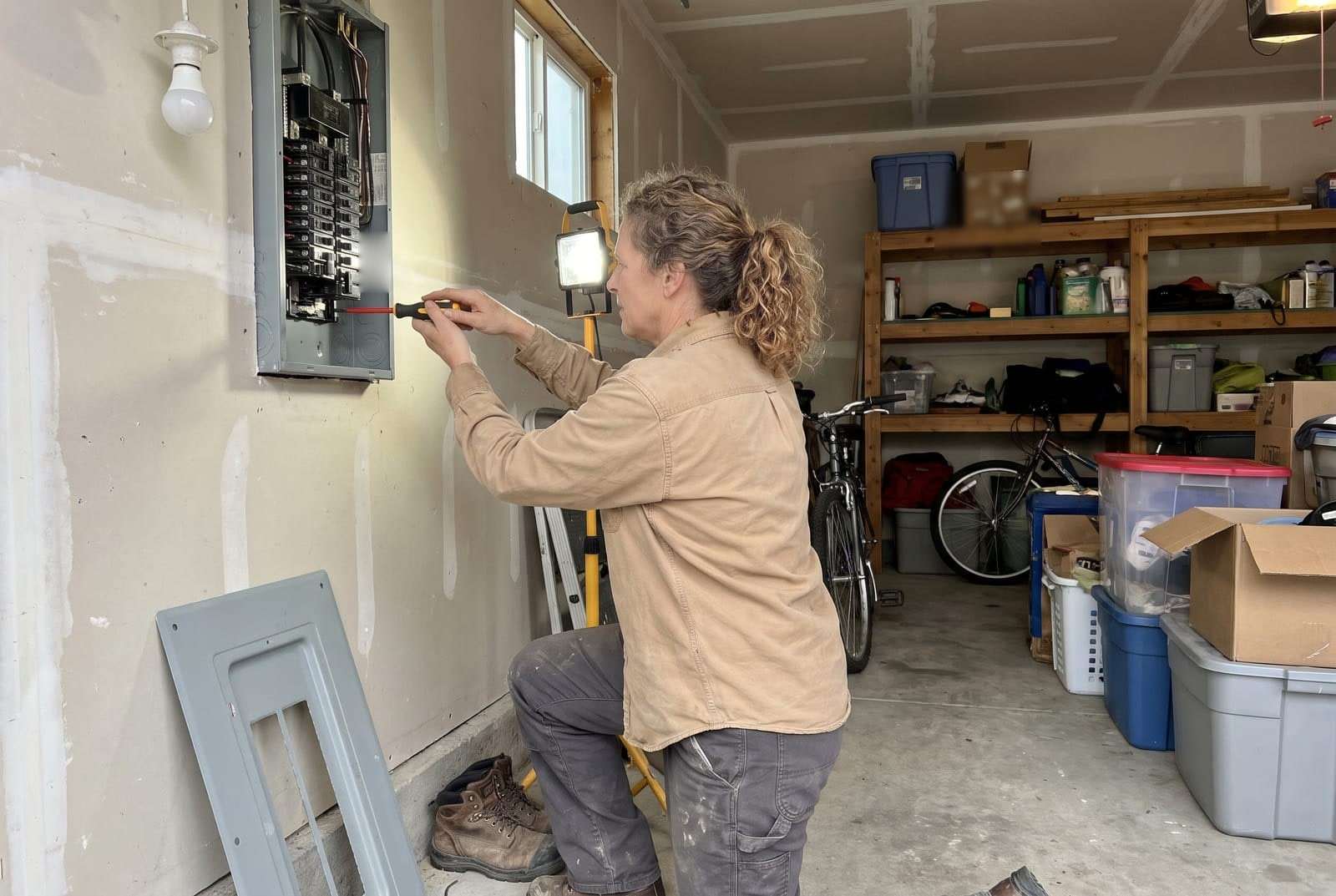
A reset is for a trip with a clear cause. Another reset only puts a faulty circuit back under stress, so stop and call if you notice any of these:
- It trips again the instant it is reset, with everything unplugged
- The breaker or the panel feels hot, buzzes or crackles
- A burning smell, or scorch marks on the panel or an outlet
- The handle will not stay on, or feels loose
- Lights flicker or dim on that circuit before it trips
- Water has reached the panel or an outlet
- A fuse keeps blowing (never fit a larger one)
Tripped breakers, dead outlets and flickering lights are where our repair and wiring work starts. A fault like this is traced before anything is replaced, from the connections at the breaker to each box on the circuit.
On the first visit, the property is walked and the outlets and circuits are tested, and you hear what was found and what the repair will involve.
Resetting a Breaker the Safe Way
A reset is safe with dry hands, a dry floor and only the panel door open, never the metal cover behind it.
- Switch off what was running. Turn off the lights and unplug the appliances on that circuit.
- Find the tripped breaker. Its handle sits between on and off, or shows a colored flag in a small window.
- Stand to one side. Stand beside the panel rather than square in front of it.
- Push the handle fully off. A tripped breaker has to reach off, usually with a click, before it will latch again.
- Push it back on. If it trips again at once, stop: a second try will not change the answer.
- Bring things back one at a time. If one item trips it, you have found the cause. Note the circuit, what ran and the time.
A GFCI outlet resets at the outlet itself. If several outlets in a bathroom, the garage or the basement go dead at once, find the GFCI that protects them, sometimes in another room, and press RESET.
More About Breakers and Resets
How often is too often for a breaker to trip?
A trip now and then with an obvious cause is the breaker doing its job. One that trips with ordinary use, or more often than it used to, is telling you something has changed: have the circuit checked rather than keep resetting it.
Why do GFCI and AFCI breakers trip when nothing seems wrong?
They react to faults far smaller than an ordinary breaker notices: a few thousandths of an amp leaking to ground, or the pattern of arcing from a worn cord. Moisture, an aging appliance, some motors, or one neutral serving two circuits can set them off. If they trip with everything unplugged, the cause is in the wiring.
What does it mean when a breaker will not reset?
First make sure the handle went fully to off; a breaker will not latch from the middle. If it still springs back with the circuit unplugged, a short is still present or the breaker has failed. Leave it off and do not hold or force the handle.
Is a warm breaker a problem?
Slight warmth under a heavy load can be normal. A breaker that is hot to the touch, buzzes, smells of burning or has discolored plastic around it usually has a loose terminal or a poor grip on the bus bar. Switch off what you can on that circuit and call.
Can I replace a breaker myself?
It is not a homeowner job. It means taking the panel cover off, and the wires feeding the main breaker stay live even with the main switched off. The new breaker must also be listed for that panel and sized for the wire; a larger one removes the protection.
Finding an Overloaded Circuit
An overload trips after a delay, while several things run, and resets without trouble once the load is lighter. To confirm one:
- Switch the breaker off and note every outlet and light that goes dead: that is the circuit.
- Add up the watts on the appliance labels; a space heater or a hair dryer on high draws about 1,500.
- Compare the total with the breaker: about 1,800 watts on 15 amps and 2,400 on 20, and well under that for anything that runs for hours.
Spread the load, or give a heavy appliance a circuit of its own. Never fit a larger breaker on the same wire: the wire sets the breaker size, and a bigger one only lets the wire run hotter. When the panel has no room for a new circuit, a panel upgrade comes into the picture.
Outdoor Circuits and Storm Trips
Outdoor circuits trip for reasons of their own in Northeast Ohio. Spring and summer thunderstorms drive rain into outlet boxes and fixtures, and in winter, heat tape and holiday lights on outdoor GFCI outlets trip when connections get wet or insulation cracks. A circuit that trips with every storm but holds in dry weather usually has a missing in-use cover or a fixture with a gap.
Symptoms and Next Steps Side by Side
For each pattern of trips, the usual cause, what you can look at yourself and when the job passes to an electrician:
Swipe left to see the rest of the table.
| Symptom | Likely cause | What you can check | When to call |
|---|---|---|---|
| Trips the moment it is reset | A short or a ground fault in the wiring or a device | Unplug everything on the circuit and try once more | If it trips again with nothing connected |
| Trips a few minutes into heavy use | An overload: more than the circuit is sized to carry | What runs together; move one heavy load elsewhere | When ordinary use keeps tripping it |
| Trips when one appliance starts | A fault in that appliance or its cord, or a motor’s starting draw | Run the appliance on another circuit | If it trips on this circuit alone |
| Trips at random | A loose connection, a damaged cable or a worn breaker | Warm or discolored cover plates; a note of each trip | Soon, since random trips take testing to trace |
| GFCI outlet keeps tripping | Moisture, a worn cord or an aging appliance | Unplug what it protects; dry and close outdoor covers | If it trips with nothing plugged in |
| AFCI breaker keeps tripping | Arcing in a cord or a connection, or a cable pierced by a nail | Unplug the circuit; look for pinched cords | If the trips continue with the circuit empty |
| Trips in storms or rain | Water in an outdoor box or fixture, or a damaged buried cable | Missing covers, gaps, cords left on the ground | If it trips in dry weather or a box holds water |
| Will not reset | A short still on the circuit, or a failed breaker | That the handle went fully to off first | Now, without forcing the handle |
| Warm, buzzing or a burning smell | A loose terminal, or a breaker failing at the bus bar | Nothing inside the panel; switch off what you can | Right away |
Still Tripping After a Careful Reset
A note of the circuit, what was running and how quickly it tripped is the best place for the tracing to start.